
Innovation Fast-tracks Agricultural Renewal
A staff member is conducting breeding experiments in a greenhouse in Zhangye city, Gansu province. (PHOTO: XINHUA)In 2025, China made great strides in transforming agricultural innovation to actual pr
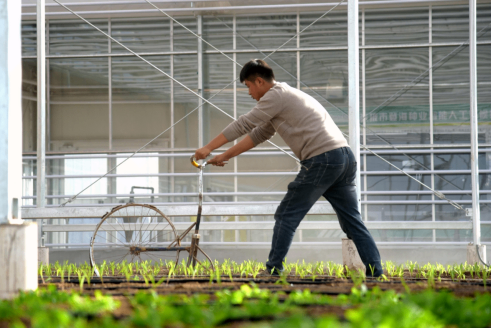
A staff member is conducting breeding experiments in a greenhouse in Zhangye city, Gansu province. (PHOTO: XINHUA)
In 2025, China made great strides in transforming agricultural innovation to actual productive forces, with sci-tech innovation in agriculture becoming a crucial support system for rural revitalization.
The country unveiled its "No. 1 central document" for 2025 in February last year, outlining priorities to deepen rural reforms further and specific steps to advance all-around rural revitalization.
China plans to support the development of smart agriculture and expand the application scenarios of technologies such as AI, big data and low-altitude systems, according to the document.
In March 2025, a "100 counties, 10,000 hectares" technology integration demonstration project was initiated. The year-end data shows that this led to the increase of yield and income with less usage of fertilizer and pesticide in over 50 kinds of crops planted in 61 counties across 18 provinces.
The field crops witnessed an average yield growth of five to eight percent, and the figure for cash crops is 10 to 15 percent.
An interest sharing mechanism was also established among governments, enterprises, research institutes and farmers during the project, to ensure maximized value for each party, according to Mei Xurong, project leader and researcher at the Chinese Academy of Agricultural Sciences.
Through clear obligation and benefit distribution agreements, the four parties united and achieved a win-win situation where governments get grain, enterprises get access to market, experts get data, and farmers get income.
In May 2025, seven departments, including the Ministry of Agriculture and Rural Affairs and the Ministry of Science and Technology, jointly released guidelines on accelerating the overall efficiency of the agricultural science and technology innovation system.
Substantial achievements were made throughout the year. One example is unmanned aerial vehicles (UAVs), which have become a new type of farm tool in Gansu province, driven by the "low-altitude economy + rural revitalization" practices spearheaded and promoted by the provincial science and technology department. This has seen the development of a new generation of tech-savvy rural UAV pilots.
They are driving prosperity, helping solve challenges in mountainous agricultural development, and injecting vitality into rural revitalization.
In Yuanmou county, Yunnan province, examples of smart agriculture can be seen everywhere. The breeding time for highland barley has been cut by half and 26 new tomato species have been bred via molecular breeding. Crop planting and management are now using the Internet of Things, via over 3,700 sensors, while an intelligent water-fertilizer integration system enables remote operation, with comprehensive coverage of technologies, including factory-based seedling cultivation and efficient water-saving irrigation.
Many innovation modes, such as "Science and Technology Matchmakers," "Science and Technology Commissioners," and "Science and Technology Backyards," were adopted by local governments and research institutes to promote the deep integration of science, technology and industries.
Sun Jiabo, leader of the urban agriculture team at Shandong Academy of Agricultural Sciences (SAAS), was seconded to a county-level government, where he served as deputy magistrate in charge of science and technology of Boxing county, Binzhou city, and also worked as a science and technology matchmaker.
"To understand the needs [of the area], I visited every town, street and enterprise in Boxing," Sun said, adding that he also learned about the good crop species and technologies of SAAS, so that they can be connected. "The team is here, the project is here, and technology becomes tangible productivity."